By: Azania Rising
Before we speak of laws, let us speak truth. Our clinics are overcrowded. Our schools are underfunded. Our job market is brutal. When you see a foreign national accessing these same services, it is natural to ask: “How can they get help when we struggle?”
That question deserves an answer.
Our public resources have limits. The healthcare system buckles under demand. Housing is scarce. The government has finite money. These are facts, not opinions. Migrants, like citizens, must understand that South Africa cannot be a bottomless well. The civility we extend must be met with respect for our laws, our culture, and our reality.
But here is the deeper truth: migrants make up less than 5% of South Africa’s population . Our struggles—unemployment, failing clinics, poor schools—are primarily the result of governance failures, corruption, and decades of neglect . The foreigner is not the cause. They are a mirror.
The Law: What It Says and What It Penalises
South Africa has clear immigration laws. They are not cruel. They are not arbitrary. They exist to bring order to movement.
Legal Avenues to Stay
A foreign national can stay legally through:
Pathway Purpose Key Requirement
Visitor’s Visa Tourism, short visits Up to 90 days. Proof of funds and return ticket
Study Visa Education Acceptance letter from a registered institution
General Work Visa Employment Job offer. Employer must prove no local could fill the role
Critical Skills Visa Scarce skills Qualification in a field South Africa needs
Business Visa Investment Capital to invest and a business plan
Retirement Visa Retirees Proof of sufficient income to support oneself without working
Relative’s Visa Family Direct relation to a South African citizen or resident
Asylum Seeker Permit Fleeing persecution Application at a Refugee Reception Office. Valid for up to 6 months
For refugees and asylum seekers, the process is separate. They apply for a Section 22 permit, which legalises their stay while their claim is processed . They have a responsibility to carry their document at all times, renew it on time, and inform Home Affairs if they move address . They are entitled to constitutional rights, but not to vote or form political parties .
Penalties for Breaking the Law
The law is not toothless. If a migrant is found undocumented:
· Entry without a visa: Fine or imprisonment up to 2 years
· Failing to depart when ordered: Fine or imprisonment up to 4 years
· Overstaying: Administrative fine up to R8,000
For employers who exploit undocumented workers: The penalties are harsher. This is not to protect migrants over South Africans—it is to protect all workers from exploitation.
Offence Penalty
Knowingly employing an illegal foreigner (1st offence) Fine or imprisonment up to 1 year
2nd offence Fine or imprisonment up to 2 years
3rd or subsequent offence Imprisonment up to 5 years without option of a fine
Hiring a foreigner without verifying their status Fine up to R100,000 (increasing)
Proposed new civil penalties under Employment Services Amendment Bill Up to R1 million for repeat offenders
The law also presumes that if you employ an undocumented person, you knew they were undocumented—unless you can prove otherwise . This makes exploitation risky.
For public servants: If an official facilitates illegal immigration, they face up to 15 years imprisonment .
For anyone manufacturing fake documents: Up to 10 years without a fine .
Unintended Consequences: When the Law Is Disregarded
When migrants stay outside the law, everyone suffers.
For the migrant: They live in fear. They cannot open a bank account. They cannot report abuse to police without risking arrest. They become prey to criminals who extort them. They cannot seek proper healthcare without fear of being reported. They are trapped in a life of shadows .
For the South African worker: When employers can hire undocumented labour for R20 an hour, why would they pay you R50? The migrant’s illegality undercuts your wages. It creates a race to the bottom.
For the community: When migrants are undocumented, they are invisible. They contribute no taxes. They have no voice. They cannot participate in community development. And when vigilantes target them, they cannot report crimes without fear—leaving us all less safe .
For the state: Limited resources are wasted on enforcement, deportation, and legal battles—resources that could be used for clinics, schools, and job creation. The Department of Home Affairs has only 868 immigration officers for the entire country . They are overwhelmed.
The recent repatriation of 4,286 foreign nationals and deportation of another 419 came at great cost—not just financial, but human .
The Price of Violence: What We Lose
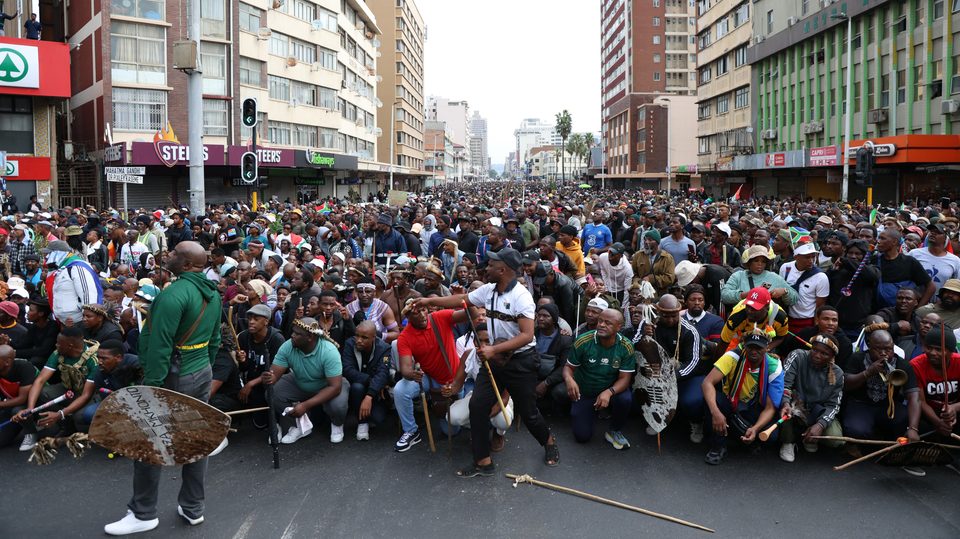
When vigilante groups issue ultimatums, when people are attacked for their accents, when shops are looted—what do we gain?
We gain nothing. We lose everything.
Sudanese refugee Hashim Noor, who fled the conflict in Khartoum, told reporters he has asked his children to stop attending school because he fears they will be attacked on the way . A Malawian migrant said: “We are being hunted like wild animals. There is no humanity anymore.”
This is not the South Africa we fought for.
When we drive out foreign shop owners, the shops close. When the shops close, no one pays rent to the landlord. No one buys stock from the local wholesaler. No one employs the local youth who worked as a cashier. The economy shrinks. We become poorer, not richer.
When we resort to violence, we scare away investment. We harm our reputation. We tell the world: “Do not come here. Do not invest here.” And the jobs we desperately need never arrive.
A Call to Balance
Here is the middle ground we must find:
- Migrants must respect our laws. Enter legally. Obtain the right permits. Follow the rules. Contribute taxes. This is not optional—it is the foundation of a functioning society.
- South Africans must respect the rule of law. Vigilantism is illegal. Attacking people is illegal. The law exists to protect everyone within our borders—citizen and foreigner alike . The state must ensure safety for all .
- The state must enforce the law against exploiters—not the vulnerable. The real criminals are employers who hire undocumented workers to avoid minimum wage. They are the ones who benefit from lawlessness. They must face the full penalty .
- We must demand better from government. The Department of Home Affairs is recruiting 301 additional officers to boost enforcement . The Department of Employment and Labour is recruiting 10,000 inspectors . This is progress. But we must hold them accountable. We must demand results.
- We must invest in Africa. The African Continental Free Trade Area is an opportunity to create jobs across the continent. If we invest in Malawi, Nigerians, Zimbabweans, and South Africans benefit. Migration pressure reduces. We grow together.
Your frustration is real. Your pain is valid. But your enemy is not the man selling vegetables on the corner. That man is running from the same system that is failing you—a system of global inequality, exploitation, and injustice.
He is not your enemy. He is your mirror.
The question is not “Who is to blame?” The question is “What world do we want to build?”
Do we want a world where everyone plays by the rules, contributes, and is treated with dignity?
Or do we want a world where fear rules, violence erupts, and we all lose?
Let us choose wisely.